


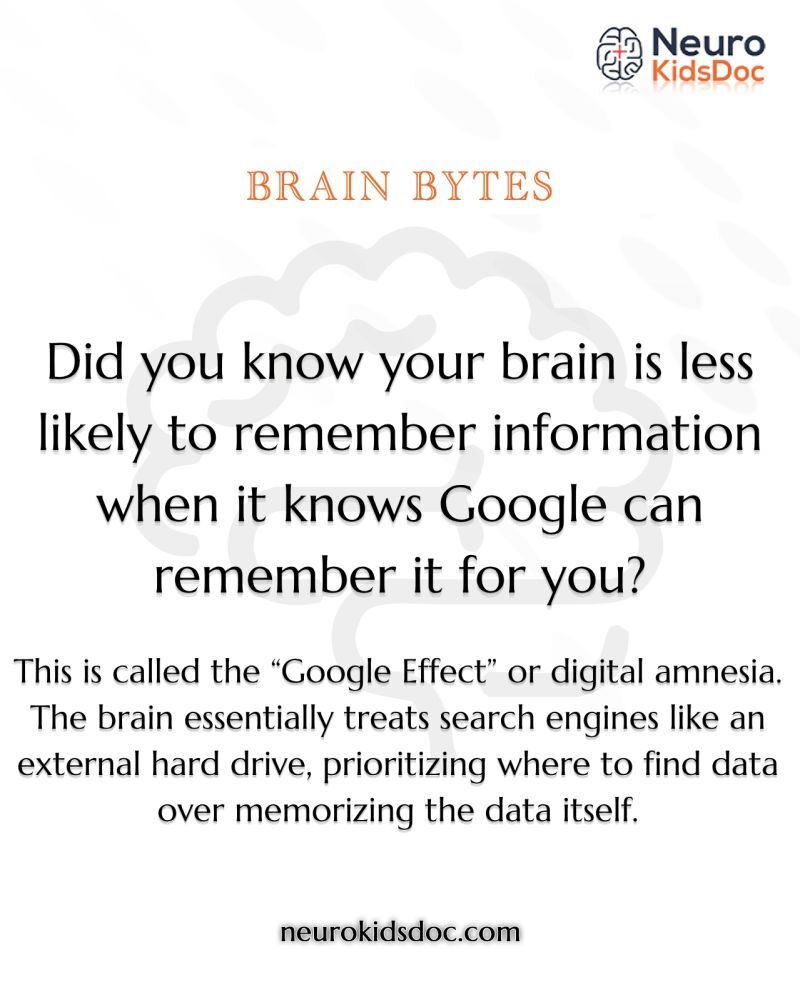
Researchers call this the “Google Effect” or digital amnesia.
Studies show that when the brain knows information can be easily searched online later, it becomes less likely to store the information deeply in memory. In simple terms, the brain adapts by remembering where to find the information instead of fully remembering the information itself. This is not necessarily “bad.” The brain is actually being efficient.
But there is an important trade-off.
Memory is strengthened through attention, repetition, effort, and retrieval. When we constantly outsource remembering to devices, the brain gets fewer opportunities to build those deeper neural pathways.
This is especially relevant for children and teenagers whose brains are still developing attention, working memory, and learning systems.
Interestingly, research also shows that we remember information better when we write things down by hand, actively recall information, explain concepts to others, read deeply instead of skimming, and pause and think before immediately searching.
The brain strengthens what it repeatedly uses. Technology is incredibly useful. But sometimes, giving the brain the chance to struggle, retrieve, and remember is part of how learning becomes lasting.
Just a decade ago, we used to remember 10–20 phone numbers by heart, whereas today many people struggle to recall even their own, or their second mobile number.
Do you still memorize important things like contact numbers?