


Why Do Children Ask the Same Question Again and Again? The Neuroscience Behind Repetition and Learning
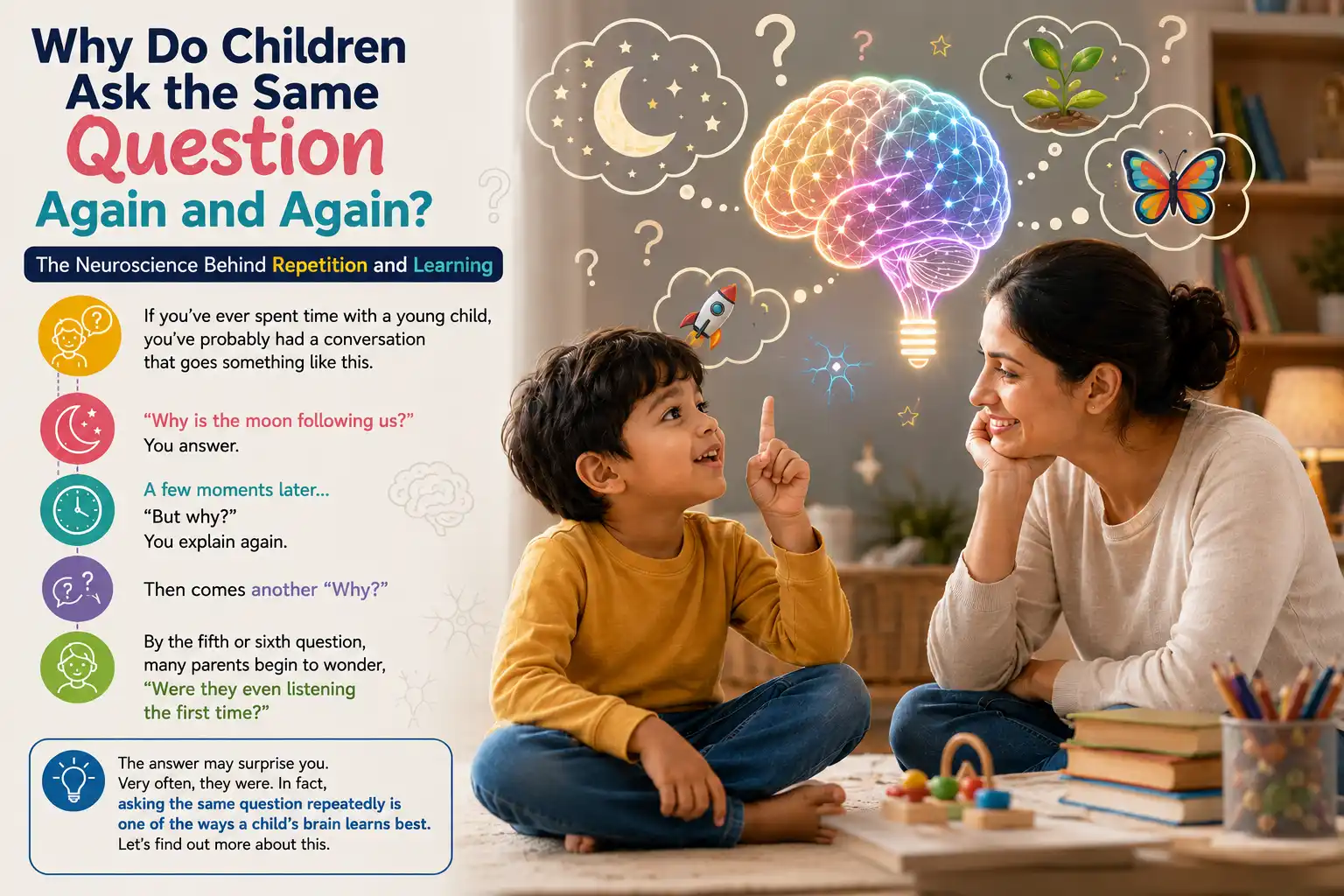
If you’ve ever spent time with a young child, you’ve probably had a conversation that goes something like this.
“Why is the moon following us?”
You answer.
A few moments later…
“But why?”
You explain again.
Then comes another “Why?”
By the fifth or sixth question, many parents begin to wonder, “Were they even listening the first time?”
The answer may surprise you. Very often, they were. In fact, asking the same question repeatedly is one of the ways a child’s brain learns best. Let’s find out more about this.
The brain is built to learn through repetition
One of the most remarkable features of the human brain is neuroplasticity, its ability to change and strengthen itself through experience.
Neuroscientists often describe this with a simple phrase: “Neurons that fire together, wire together.”
Every time your child hears a new word, practises a skill, or revisits an idea, the same networks of brain cells become active. With repetition, these connections grow stronger and more efficient.
It can be compared to walking through a grassy field. The first time you walk across it, the path is barely visible. Walk the same route every day, and eventually a clear trail appears.
The brain works in much the same way. The more often it uses a pathway, the easier it becomes to travel.
Why children repeat the same questions
Parents sometimes assume repeated questions mean their child has forgotten the answer. That can happen, but it’s only one possibility.
More often, children are doing something much more sophisticated. They may be checking whether your answer stays the same. Connecting the new information to something they already know, practising new language, or simply satisfying a growing curiosity about how the world works.
For younger children, repetition also provides a sense of predictability and emotional security. Hearing the same answer from a trusted adult helps them make sense of a world that is still very new.
Repetition helps turn learning into memory
Learning doesn’t happen the moment we hear something. The brain has to strengthen and stabilise those new connections over time.
One of the key structures involved is the hippocampus, which plays an important role in forming new memories.
Each time information is recalled or revisited, communication between brain cells becomes stronger through a process called long-term potentiation. Repeated practice also supports myelination, where nerve fibres become better insulated, allowing signals to travel faster and more efficiently.
In simple terms, repetition helps the brain move information from “I’ve heard this before” to “I know this.”
Why children love the same story again and again
Many parents wonder why their child wants the same bedtime story every single night. The answer is surprisingly simple. The brain loves familiarity while it is learning.
Every rereading helps strengthen vocabulary, language patterns, sequencing, attention, and memory. As children become familiar with the story, they also begin to predict what comes next, notice new details, and make connections they may have missed before.
What feels repetitive to us is often deeply enriching for a developing brain.
Learning takes time, and that’s okay
As adults, we sometimes expect learning to happen quickly. Children remind us that the brain doesn’t work that way. Think about how we learn almost any skill, be it walking, speaking, reading, riding a bicycle, or playing an instrument.
None of these are mastered after one attempt. They become easier because the brain strengthens the same pathways over hundreds or even thousands of repetitions.
Learning is not built on perfection. It is built on practice.
How parents can support the learning brain
The good news is that you don’t need expensive toys or complicated activities to help your child’s brain grow. Simple, everyday moments are incredibly powerful.
- When your child asks another “why,” try to see it as curiosity rather than repetition.
- Read favourite books again, even if you know every page by heart.
- Sing the same songs.
- Repeat familiar routines.
- Encourage your child to explain things back to you in their own words. Teaching and recalling information are some of the best ways to strengthen memory.
A final thought
The next time your child asks the same question for what feels like the hundredth time, remember this: They are not trying to test your patience. Their brain is strengthening connections that will support learning for years to come.
While repetition is a normal tool for learning, persistent memory or attention challenges may benefit from expert insight. For clear answers and specialized support, connect with Dr. Aman PS Sohal, a leading pediatric neurologist in Dubai.