


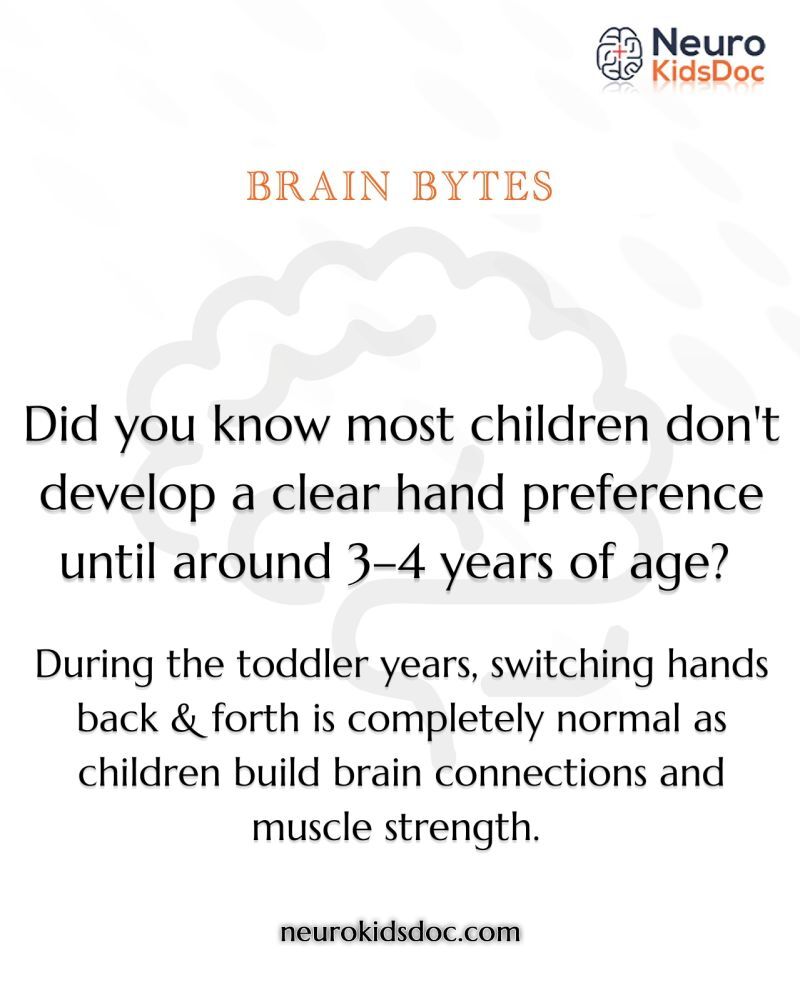
Many parents worry when they notice their toddler switching between the left and right hand while eating, drawing, or playing.
In most cases, this is completely normal.
During the first few years of life, the brain is still developing the networks responsible for movement, coordination, and motor control. As these pathways mature, children gradually develop a preference for using one hand more consistently than the other.
By around 3 to 4 years of age, many children begin to show a clearer hand preference, although for some, it may continue to develop until 5 or 6 years of age.
One important point for parents is this:
Children should never be forced to switch from their naturally preferred hand. Whether a child is left-handed or right-handed is a normal variation in brain development, not something that needs to be corrected.
What matters far more than which hand your child uses is whether they are developing good coordination, strength, and fine motor skills with that hand over time.
If your child continues to use both hands equally beyond the preschool years, or if there is a sudden loss of hand preference or weakness in one hand, it’s worth discussing this with your pediatrician or pediatric neurologist.
Every child’s brain develops at its own pace, and sometimes, patience is exactly what developing brains need.
FAQ
Is it normal for my toddler to switch between both hands?
Yes. Many toddlers use both hands interchangeably while eating, drawing, or playing. A clear hand preference often develops gradually between 3 and 6 years of age.
Should I encourage my child to use one hand more than the other?
No. Children should never be forced to switch or choose a particular hand. Left-handedness and right-handedness are both normal variations of brain development.
When should I consult a pediatric neurologist about hand preference?
You should seek medical advice if there is a sudden loss of hand preference, weakness in one hand, difficulty using one side of the body, or concerns about your child’s motor development.
Can hand preference tell us anything about brain development?
Yes. Developing a preferred hand is part of the brain’s natural maturation process as motor control and coordination pathways become more specialized during early childhood.