


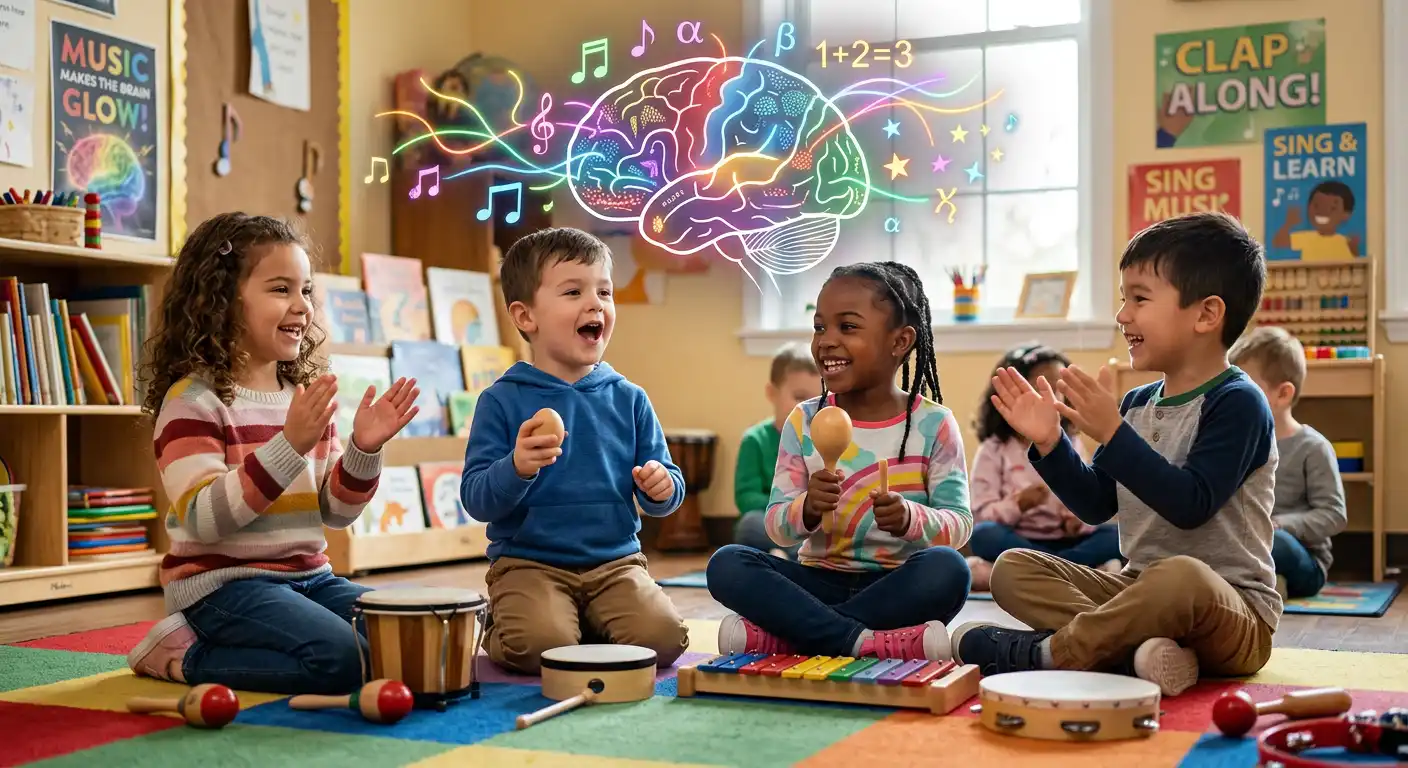
Did you know that music is one of the few activities that activates almost the entire brain at the same time? It is absolutely fascinating.
While other activities might use isolated regions of the brain, music simultaneously recruits auditory, visual, motor, memory, and emotional areas. When your child sings, claps to a rhythm, or learns an instrument, their brain is doing far more than simply enjoying a tune.
In fact, active music learning is a true “whole-brain workout.” Let’s dive into the incredible neuroscience behind music and discover how it supports healthy child brain development.
The Neuroscience of Melody: What’s Happening Inside?
Neuroscience research shows us that regular music engagement does some amazing things to a child’s developing brain. Here is a look under the hood:
- Strengthening the Brain’s Bridge: Active music-making helps strengthen the corpus callosum. This is the thick band of nerve fibers that connects the left and right hemispheres of the brain. A stronger connection here means faster, more efficient communication between both sides of the brain.
- Stimulating the Hippocampus: Music stimulates the hippocampus, a deeply seated, rudimentary area of the brain. The hippocampus is heavily involved in learning, memory formation, and emotional processing.
By engaging these critical areas all at once, music lays down strong neural pathways that benefit children for the rest of their lives.
Big Benefits of Early Music Exposure
Because music engages so many areas of the brain simultaneously, its benefits ripple out into almost every area of a child’s life:
- Accelerated Language Development: The brain processes the rhythms of language and the rhythms of music in very similar ways. Early exposure to music helps kids decode sounds and words much faster.
- Sharper Attention and Focus: Learning to follow a beat or keep time with a song requires sustained attention, which helps build strong focus and concentration skills.
- Better Emotional Regulation: Music is deeply tied to our emotions. Sing-alongs and musical play give children a healthy, creative outlet to express and manage their feelings.
- Mathematical and Pattern Thinking: Music is full of patterns, fractions (half notes, quarter notes), and tempos. Children who engage with music often develop stronger spatial-temporal reasoning and mathematical thinking.
Active vs. Passive: Why Your Child Needs to Play, Not Just Listen
Here is something incredibly important for parents to keep in mind: the biggest brain benefits come from active involvement, not just passive background music.
While playing classical music in the background is lovely, it doesn’t spark the same neural fireworks as active participation. To get that true “whole-brain workout,” your child needs to physically interact with the sound.
When a child claps their hands, dances, or taps a drum, they are coordinating their motor skills with their auditory senses. This active sensory integration is where the real brain-building magic happens!
Simple Ways to Bring Music into Your Daily Routine
You don’t need to be a concert pianist to give your child the benefits of music. In fact, the best musical experiences are simple, playful, and interactive.
Here are a few easy ways to get started today:
- Sing Together: Sing in the car, make up silly songs during bath time, or sing a soothing lullaby before bed.
- Clap the Rhythm: Play a song and practice clapping along to the beat. You can also clap a simple pattern and ask your child to repeat it back to you.
- Dance Parties: Turn on your favorite upbeat tunes and dance around the living room. This is fantastic for motor skill coordination and emotional release.
- Introduce Simple Instruments: Get some child-friendly instruments like shakers, tambourines, or a small keyboard. Play along with them and watch their emotional and physical development soar.
Start Your Musical Journey Today
Music is a beautiful, joyful, and completely free tool that you can use to boost your child’s brain health. So, grab a makeshift shaker (a plastic bottle filled with rice works perfectly!), sit down with your child, and start making some noise together.
For more scientific insights on pediatric brain development and tips to help your child thrive, visit us at NeuroKidsDoc.