



“Everyone else in my class is on it.”
This is one of the most common sentences parents hear today.
And it puts you in a difficult spot. You don’t want your child to feel left out. But at the same time, you wonder, is their brain really ready for this?
With more and more countries limiting or banning social media for children, it becomes increasingly important for us as parents to understand how a child’s brain develops and how social media can influence it.
Why does it matter?
Social media is more than a simple tool. It interacts directly with how the brain develops.
Every like, comment, and notification has an impact. It activates the brain’s reward system, and releases dopamine, the chemical linked to motivation and habit formation.
For a developing brain, this system is especially sensitive. Which means social media doesn’t just entertain or help them make connections. It has the potential to shape attention, behaviour, and emotional responses.
Understanding the developing brain
To understand this better, let us see how the brain develops.
The emotional and reward centers of the brain develop earlier, during early adolescence (ages 10–13). On the other hand, the control center, known as the prefrontal cortex, develops much later, well into the early 20s. It is responsible for decision-making and impulse control.
In other words, the emotional “accelerator” is ready early, but the “steering wheels” and “brakes” are still in progress.
This is why children and teenagers are more likely to seek rewards quickly, struggle with impulse control, be more affected by peer feedback, and find it harder to disconnect.
So what age is “appropriate”?
Most social media platforms set 13 as the minimum age. But from a neurological perspective, no two kids are alike, and some children at 13 may be able to use social media effectively, while others may not.
Research and clinical experience suggest that earlier exposure to social media increases vulnerability, especially to comparison and self-esteem issues, sleep disruption, attention difficulties, and emotional reactivity.
We also need to understand that social media is hardly static; the algorithm, rules, and structure change frequently, and they are explicitly designed to keep you online longer by maximizing engagement. If it is difficult for us, as adults, to navigate this, we can only imagine what it is like for an unsupervised child.
Signs your child may be ready to use social media
Instead of focusing only on age, it helps to look at behaviour.
A child may be more ready if they:
- can follow limits without constant reminders
- manage frustration reasonably well
- understand that online content is not always real
- talk openly about what they see and feel
These skills take time and effort (from parents and the child) to build. If these skills are still developing, introducing social media may feel overwhelming for their brain.
A better approach: start slow, stay involved
Instead of introducing social media all at once, which can feel overwhelming for a child’s brain, it helps to ease into it gradually.
Starting a little later, if possible, and giving limited access rather than full independence can make a big difference. Simple habits like keeping devices out of the bedroom at night and setting clear, predictable time limits help create structure.
Just as important is staying involved, knowing what your child is using and how they’re engaging with it.
But more than anything, keep the conversation open. Children are far more likely to share what they’re experiencing when they feel safe and understood, rather than watched or controlled.
Does banning it completely work?
Social media is a part of modern life. Avoiding it completely may not be realistic for most families. Moreover, repeatedly telling a child a plain “NO”, without explanation or alternative, can backfire because it often creates a “noise” effect where the child stops paying attention.
Over time, constant refusals can damage the parent-child relationship, fuel power struggles, and even stunt a child’s development of independence.
So, the goal is not to eliminate it. It is to introduce it at the right time, in the right way.
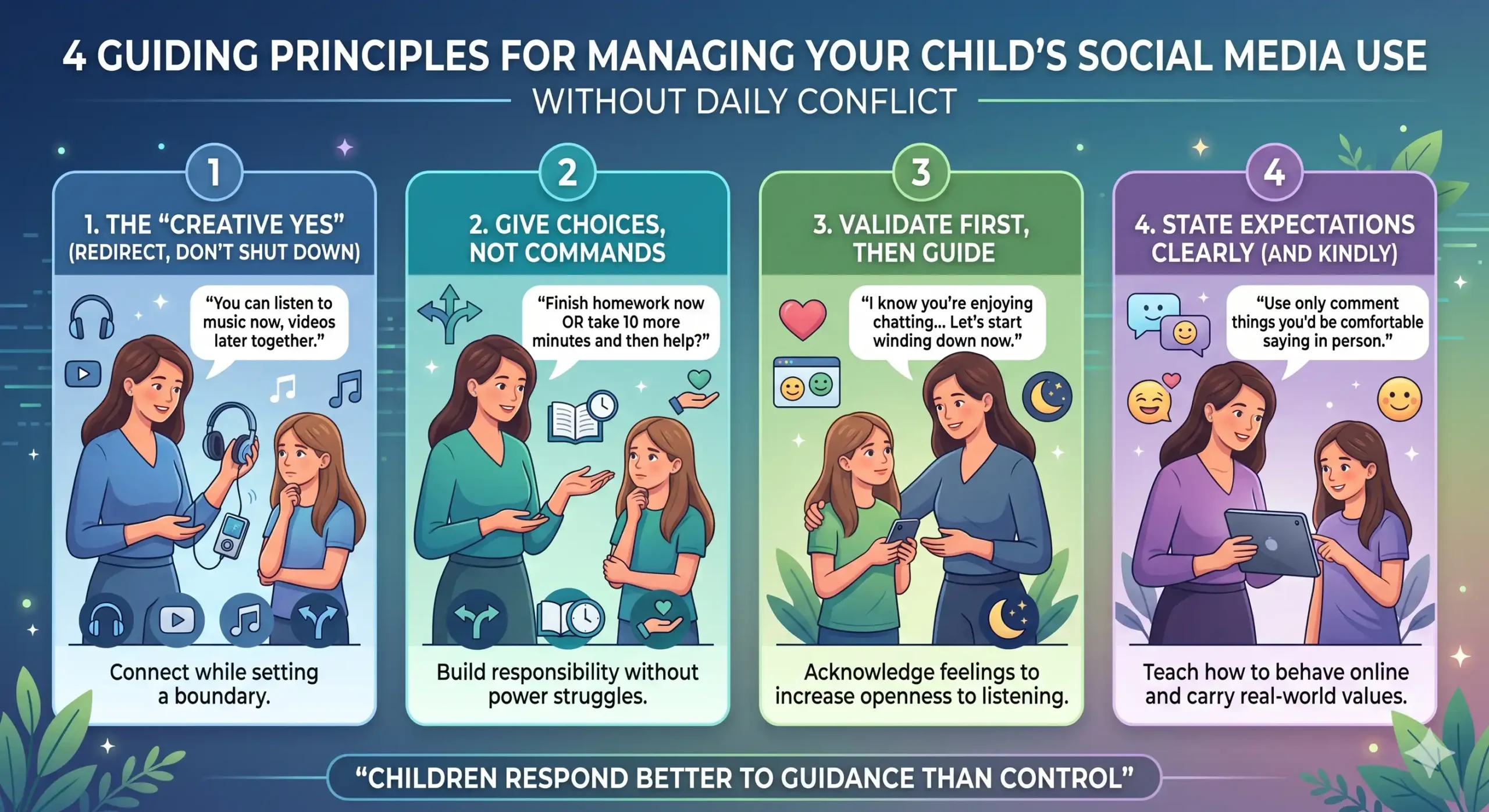
How to manage your child’s social media use? (without daily conflict)
The answer often lies not just in what we say, but how we say it.
Children respond far better to guidance than control. When we shift our language slightly, we’re not just setting boundaries, we’re teaching decision-making, self-regulation, and digital responsibility.
1.The “Creative Yes” (Redirect, don’t shut down)
Instead of a direct “no,” guide them toward a better alternative. For example, “You can listen to music right now, and we can watch videos together later.”
This keeps the connection intact while still setting a boundary.
2.Give choices, not commands
Children are more likely to listen and cooperate when they feel involved. Instead of telling them to “Get off your phone,” try “Would you like to stop now and finish your homework, or take 10 more minutes and then help me with something?”
This builds responsibility without power struggles.
3.Validate first, then guide
Before setting a limit, acknowledge what they’re feeling.
“I know you’re enjoying chatting with your friends. Let’s start winding down now so your brain gets enough rest for tomorrow.”
When children feel understood, they’re more open to listening.
4. State expectations clearly (and kindly)
Children need guidance on how to behave online. not just plain restrictions. Instead of asking them not to be rude or unkind online, you can try saying, “Let’s use only comment things you would be comfortable saying to someone in person.”
This helps them carry real-world values into digital spaces.
Summing up
In the long run, it’s not just about limiting screen time; it’s about helping them build the ability to use it wisely. This way, you’re helping your child understand and navigate the digital world with you. Over time, this shifts your role from someone who simply controls access to someone who guides and supports.
And that tends to work better because children are more likely to come to you if they see something confusing or uncomfortable online, rather than hiding it out of fear. They slowly learn important skills like managing time, handling distractions, and making better choices.
And when children understand the reasoning behind boundaries, they are far less likely to resist them.