


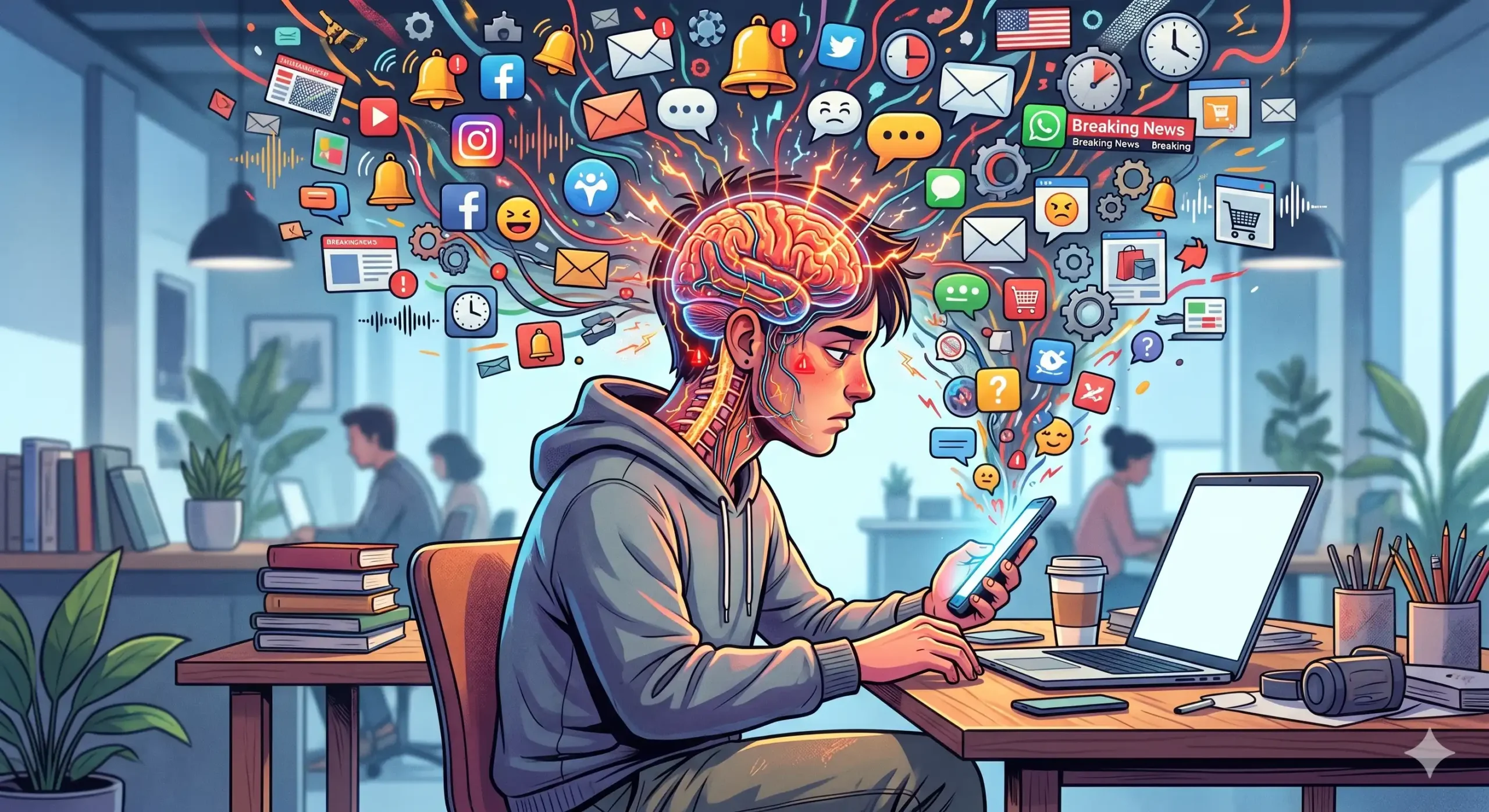
Perhaps you’ve spent the day answering messages, checking emails, scrolling through social media, helping your children, making decisions, and trying to keep up with everything happening around you. By evening, you feel irritable, distracted, and mentally drained. Yet somehow, you still find yourself reaching for your phone.
If this sounds familiar, you are certainly not alone.
Many people assume they are stressed, unmotivated, or simply not managing their time well enough. But sometimes the issue is something different, i.e., overstimulation.
What is overstimulation?
Overstimulation occurs when the brain is asked to process more information than it can comfortably manage for extended periods of time.
This information does not have to be dramatic or stressful. It can come from notifications, conversations, emails, social media, news updates, background noise, advertisements, decision-making, multitasking, and constant visual input.
The human brain is remarkably adaptable. However, it evolved in a world where information arrived gradually. Today’s environment often delivers more stimulation in a single day than our brains were originally designed to handle continuously.
When that happens, the nervous system starts sending signals that it needs recovery.
The problem is that these signals are easy to overlook. Let’s understand them.
1: Small things suddenly feel like big things
One of the earliest signs of overstimulation is increased irritability.
You may find yourself becoming frustrated by things that would not normally bother you. A slow internet connection, a minor inconvenience, a child asking the same question repeatedly, or a small interruption may trigger a much bigger reaction than the situation deserves.
This does not mean you are becoming less patient.
When the brain is overloaded, emotional regulation becomes harder. The nervous system has fewer reserves available to manage frustration, disappointment, and stress.
Often, the issue is not the event itself. It is the amount of mental input the brain has already been carrying throughout the day.
2: You can’t tolerate boredom anymore
Can you notice how quickly your hand reaches for your phone when there is a spare moment?
Standing in a queue, waiting for an appointment, even during bathroom breaks! Many people now find silence uncomfortable. Yet boredom serves an important purpose. It allows the brain to process information, consolidate memories, reflect, and engage in creative thinking.
When every moment is filled with stimulation, the brain loses some of its natural opportunities to reset. In fact, one of the most surprising findings from neuroscience is that some of our best ideas, insights, and problem-solving often occur when the mind is allowed to wander.
3: Your attention feels fragmented
You start reading an article and quickly find yourself checking a notification. You begin one task, remember another, answer a message, and then struggle to recall what you were originally doing. Many people describe feeling as though their attention is constantly being pulled in different directions.
Research shows that frequent task-switching places a significant burden on attention networks in the brain. Contrary to popular belief, the brain does not truly multitask very well. Instead, it rapidly switches between tasks, which consumes mental energy and reduces efficiency.
Over time, this can make concentration feel increasingly difficult.
4: You feel tired but cannot switch off
This is perhaps one of the most frustrating signs of overstimulation.
You feel exhausted, and you know you need rest. Yet your brain continues seeking more input. You scroll through videos, check messages, read headlines, or continue consuming information long after you intended to stop.
Part of the reason lies in how the brain responds to novelty and anticipation. Every swipe and every notification offers the possibility of something new.
Meanwhile, true rest becomes harder to access. Many people think they need more motivation when what they actually need is less stimulation.
5: Everything feels mentally crowded
Sometimes people struggle to explain how they feel. They are not necessarily anxious or unhappy. Their brain simply feels full, loaded with decisions, conversations, and excess information. This leads to several things competing for attention.
When the nervous system reaches this point, even simple tasks can begin to feel heavier than they should. This is often the brain’s way of asking for space.
What can help?
The solution is not always becoming more productive. In many cases, recovery begins when we reduce input rather than add more.
1.Reduce visual stimulation
One fact that surprises many people is how much of the brain is devoted to processing visual information. Vision is one of the brain’s most demanding tasks. Every reel, video, headline, image, advertisement, and social media post requires processing.
Creating a screen-free hour before sleep can help the brain gradually transition from stimulation to rest.
2.Protect your attention
Not every notification deserves immediate access to your brain.
Turning off non-essential alerts and creating periods of uninterrupted focus can significantly reduce cognitive overload.
3.Move your body
Physical activity remains one of the most effective ways to regulate the nervous system. A walk outdoors, exercise, sports, or even simple movement breaks can help lower stress and improve mental clarity.
4.Allow yourself moments of boredom
This may feel uncomfortable at first. That is okay.
The brain benefits from periods where it is not constantly consuming information. These quieter moments create space for creativity, reflection, memory consolidation, and emotional regulation.
5.Prioritise sleep
Sleep is not simply rest for the body. It is one of the most important recovery processes for the brain. Attention, memory, emotional regulation, learning, and decision-making all depend on it.
Final Thoughts
One of the most common misconceptions about mental fatigue is that it means we need to push harder. Often, the opposite is true.
If you have been feeling irritable, distracted, restless, or mentally overwhelmed, it does not mean there is something wrong with you. It may simply mean your brain has been carrying more input than it was designed to process continuously.
Sometimes the most helpful thing we can do for our nervous system is not add another productivity strategy, another app, or another task, but create moments of peace and quiet.